Accessible parking: 2 examples of fraud we must avoid
People with reduced mobility (PRM) are finding things increasingly easier thanks to the various measures taken by Governments and Public Administrations. One of these is the provision of accessible parking spaces (formerly known as disabled parking spaces).
However, in our society, there are many people who are not aware of the importance of accessible parking spaces, and they engage in fraudulent actions to take advantage of these spaces and park easily anywhere. These people are causing problems for users who genuinely need them when parking their vehicles in strategic or accessible areas of large cities.
CHARACTERISTICS OF ACCESSIBLE PARKING SPACES
Accessible parking spaces have specific characteristics designed to make parking manoeuvres easier:
The length must be at least 5 metres long.
The width of the space must be a minimum of 2.20 metres.
They must have an obstacle-free access area to make parking manoeuvres easier (at least 3 metres in both length and width).
They may be parking spaces arranged in line, perpendicular, parallel or angled. Here are some tips for parking in these three types of spaces.
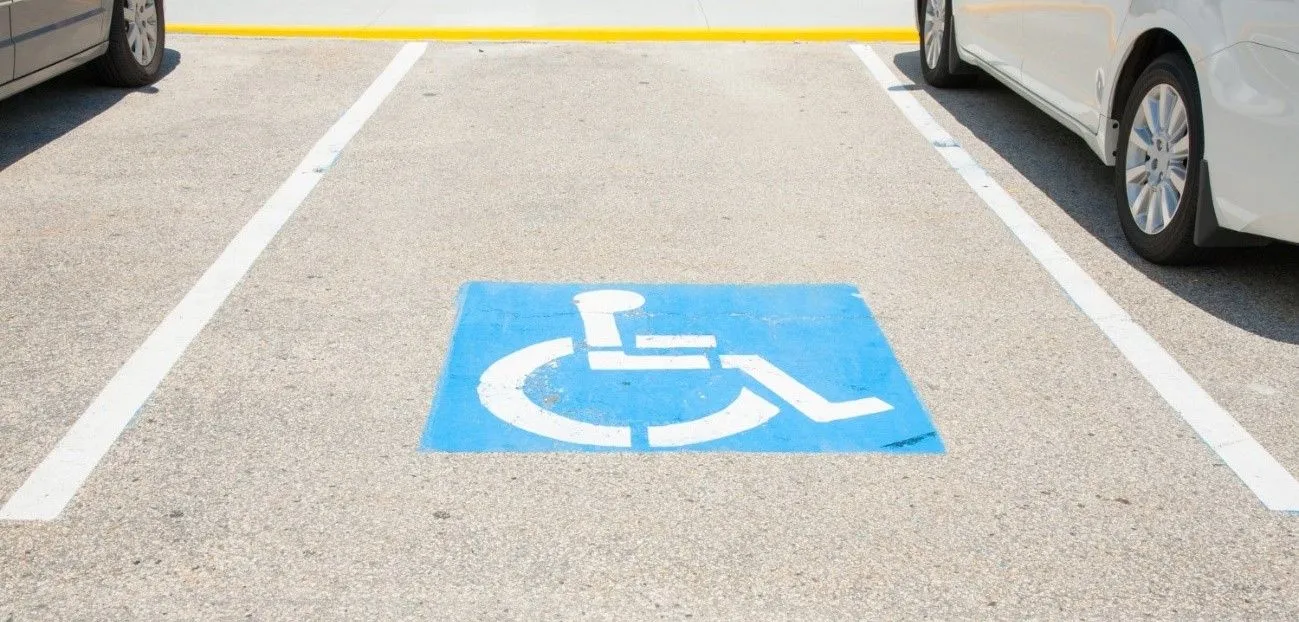
They must have both a vertical sign and ground marking to indicate that this is a parking space for people with disabilities or reduced mobility (including the international symbol of a person in a wheelchair on a blue background).
Their location must be close to a pedestrian crossing.
There must be one accessible parking space for every 40 parking spaces.
Parking in these spaces without authorisation carries a fine of €200 (plus the possible cost of the municipal tow truck if the vehicle is eventually removed).
It is considered a serious offence to park in these spaces, although it does not result in points being deducted from the driving licence, as it does not pose a road safety risk.
DGT CAMPAIGNS APPEALING TO CIVIC RESPONSIBILITY TOWARDS ACCESSIBLE PARKING SPACES
The DGT appeals to drivers’ empathy with two radio adverts under the slogan do not occupy the space that does not belong to you. This is a campaign that appeals to people’s civic responsibility so that they respect accessible parking spaces.
Many town councils across the country are also committed to awareness campaigns promoting respect for this type of parking space. They have also increased the number of penalties for vehicles using these spaces without reduced mobility status (or even fraudulently).
THE IMPORTANCE OF URBAN MOBILITY FOR PEOPLE WITH REDUCED MOBILITY
Urban mobility is of vital importance for PRM. And it must offer them the opportunity to access the services, activities and resources available in the city autonomously and independently.
Thanks to this type of parking space, people with limited or reduced mobility can access:
Basic services such as medical care, the workplace, shopping areas…
Social participation by attending events, cultural activities, festivals, etc. It is essential for people with reduced mobility to enjoy a full social life.
Accessible parking spaces prevent dependence on third parties, which implies a high level of autonomy, greater self-esteem and, in general, a better quality of life.
FRAUD: TOWNS AND CITIES RUNNING CAMPAIGNS TO DETECT THE MISUSE OF PARKING PERMITS FOR PEOPLE WITH REDUCED MOBILITY
Unfortunately, parking spaces for people with reduced mobility are a source of fraud. Many people use PRM permits belonging to deceased persons or expired permits in order to park in them.
Users of these spaces complain about this type of behaviour, where parking permits for people with disabilities are used fraudulently by people who do not have reduced mobility, causing major inconvenience to the users who genuinely need them.
Campaign by the Local Police of Castilleja de la Cuesta
This town in Seville has launched a campaign focused on the control and monitoring of accessible parking spaces.
The actions focus on increasing the tasks of monitoring and checking the PRM permits used by drivers. In this way, they can identify all those using them inappropriately or fraudulently and begin the appropriate actions to penalise them and prevent them from continuing with this uncivic and illegal practice.
Santa Cruz de la Palma
In the capital of the island of La Palma, special efforts are also being made to monitor and guarantee the proper use of accessible parking spaces.
The Local Police are responsible for removing expired, irregular or photocopied permits, as well as initiating the corresponding administrative offence procedure.
Parking spaces for people with reduced mobility are an important part of the measures aimed at improving the quality of life and autonomy of people with reduced mobility. The fraudulent and uncivic use of these spaces is becoming a real problem. That is why many town councils and the DGT itself are carrying out awareness campaigns aimed at the public.