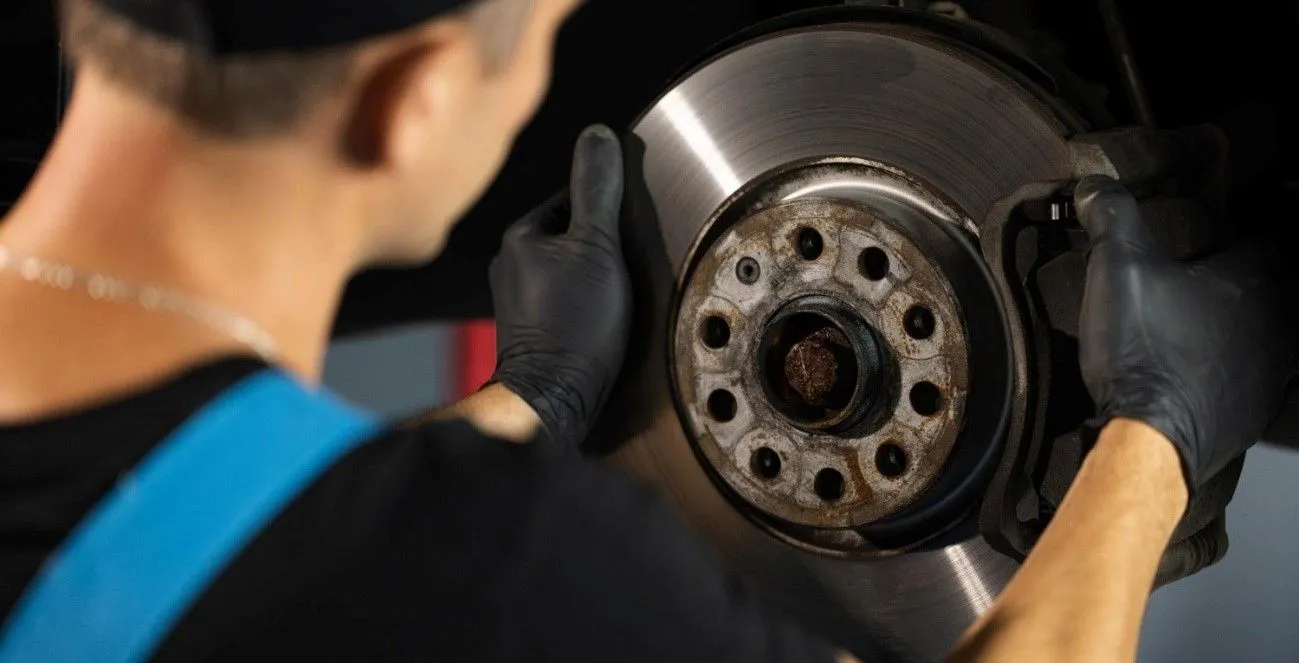
5 warning signs that it is time to replace your car’s brakes
We do not need to tell you that a car’s braking system is not something to take lightly, since your physical safety and that of your passengers depend on it working properly. What we can do, however, is warn you about the different signs and warning signals indicating that you need to change your car’s brakes or have the entire braking system checked. These are, one by one:
WARNINGS THAT INDICATE YOU SHOULD CHANGE YOUR BRAKES:
1. The brake fluid level, brake pad thickness or ABS warning lights come on
Any of these warning lights may come on because there is a real issue in the braking system, or because an electronic component is not working as it should.
If the brake fluid level warning light comes on, you should check whether the fluid level in the reservoir is indeed low. If this happens, it is because there is a drip or a small leak somewhere in the brake circuit.
If the brake pad thickness warning light comes on, the check is carried out visually. We should add that in some vehicles there is a single warning light that alerts you to anomalies in both the brake fluid level and the brake pad thickness.
And if the ABS warning light stays on continuously, the only solution is to go to a garage so they can carry out an electronic diagnostic test of the braking circuit and the ABS system.
2. Changes in brake pedal travel
If, when pressing the brake pedal with the vehicle switched on, you notice a travel that is abnormally longer than usual, this may clearly indicate that it is necessary to change your car’s brakes, as it means that:
- There is air inside the brake circuit.
- The brake fluid level is insufficient (a sign that there is a leak).
- The pads are very worn.
3. Issues when pressing the brake pedal
Sometimes there are more subtle signs indicating that we need to change the brakes immediately. It may happen that, when pressing the pedal, you notice other abnormal things, such as:
- There is little resistance to forward movement or the pedal feels spongy.
- The pedal is too hard.
- Vibrations are felt.
- The pedal sticks or locks at times.
The possible causes of the symptoms mentioned are, respectively:
- The brake fluid has deteriorated.
- The brake servo is faulty.
- The brake discs are warped.
- The movement of the brake piston is compromised and obstructions or seizing occur when pressing the pedal.
- In this case, the need to change your car’s brakes will be imminent.
4. Noise when braking
If you hear a high-pitched noise or squealing when braking, it may be a sign that:
The brake pads are so worn that they are already rubbing against the metal of the discs, which may damage them irreversibly. The pads are soaked with brake fluid or grease. The brake discs are scratched or deformed.
5. Loss of braking performance
If you notice that the car brakes less effectively or seems to pull off course when you press the brake, the cause may be any of the above. In addition, this may also be due to:
An electronic failure in the braking control system or in a sensor. The brake pads being damaged or degraded (this can happen even if the pads still have sufficient thickness). The brake master cylinder not working properly.
To avoid these and other unforeseen issues in the braking circuit, the most advisable thing is to have the vehicle undergo the inspection and maintenance services prescribed by the manufacturer.
In addition, the thickness of the pads, the condition of the discs, the brake fluid level and the possible presence of drips of this fluid should be checked visually and on a regular basis.
CAN I CHANGE THE BRAKES MYSELF?
To change a car’s brakes, some mechanical knowledge, a certain degree of manual skill and specific tools are required. In addition, after replacing the pads, the braking circuit must then be bled.
Therefore, if you lack any of these three things, our recommendation at AUSSA is that you entrust the task to a mechanical workshop or the vehicle manufacturer’s official service centre.
If it is the brake discs that need changing, the complication doubles: in addition to the discs, the pads must also be replaced, since their contact surface will have been altered due to continuous contact with the worn discs. Therefore, it is also preferable to have this done in a workshop.
Another possibility is that the element not working properly is the brake master cylinder, the brake servo or the ABS system. In this case, we are no longer talking about recommendations: it is mandatory for the car to be checked by a professional, and the same applies when the car is losing brake fluid.
In short, if you notice any sign that makes you think the braking system needs to be checked, or that you need to change your car’s brakes, the prudent decision is to drive with the utmost caution and head straight to a mechanical workshop. And if you suspect a very serious fault, ask your insurance company’s roadside assistance service for help.
If you like to keep up with urban mobility, you can find more articles and content on our Apparkya blog.